SpermidineExplainer
About 7 grams of microplastics in your brain, and what you can do about it
You can’t avoid plastic. But your cells have a way of clearing out what doesn’t belong, and there’s a molecule that switches it on.
Brands have paid for promotional consideration in these articles.

Based on recent research, you are likely carrying about 7 grams of microplastics in your brain: the weight of a plastic spoon (Nihart et al., Nature Medicine, 2025).
They’re in your blood, too. In a 2022 study, microplastics were detected in the blood of 77% of healthy adults (Leslie et al., Environment International).
There isn’t much any of us can do to avoid them. Plastic is everywhere, and it isn’t going away.
What you can do something about is what happens once the particles are inside your cells.
How your cells take out the trash
Your cells have a way of dealing with everything that shouldn’t be there: worn-out proteins, broken machinery, cellular debris.
It’s called autophagy, from the Greek for “self-eating.” The cell wraps the material up, breaks it down, and rebuilds fresh from the parts.
The 2016 Nobel Prize in Physiology or Medicine was awarded for discovering how autophagy works.
When your cells detect nanoplastics, the smallest plastic particles, they try to clear them using autophagy.
What plastic does to it
But plastics jam the system. The recycling machinery stalls, mitochondria get damaged, and inflammation spikes.
Mitochondria are the parts of a cell that make its energy.
And autophagy was already slowing down. It slows with age, and the junk it once cleared piles up.
You need help cleaning up the microplastics
Your body produces spermidine for one reason: to launch autophagy.
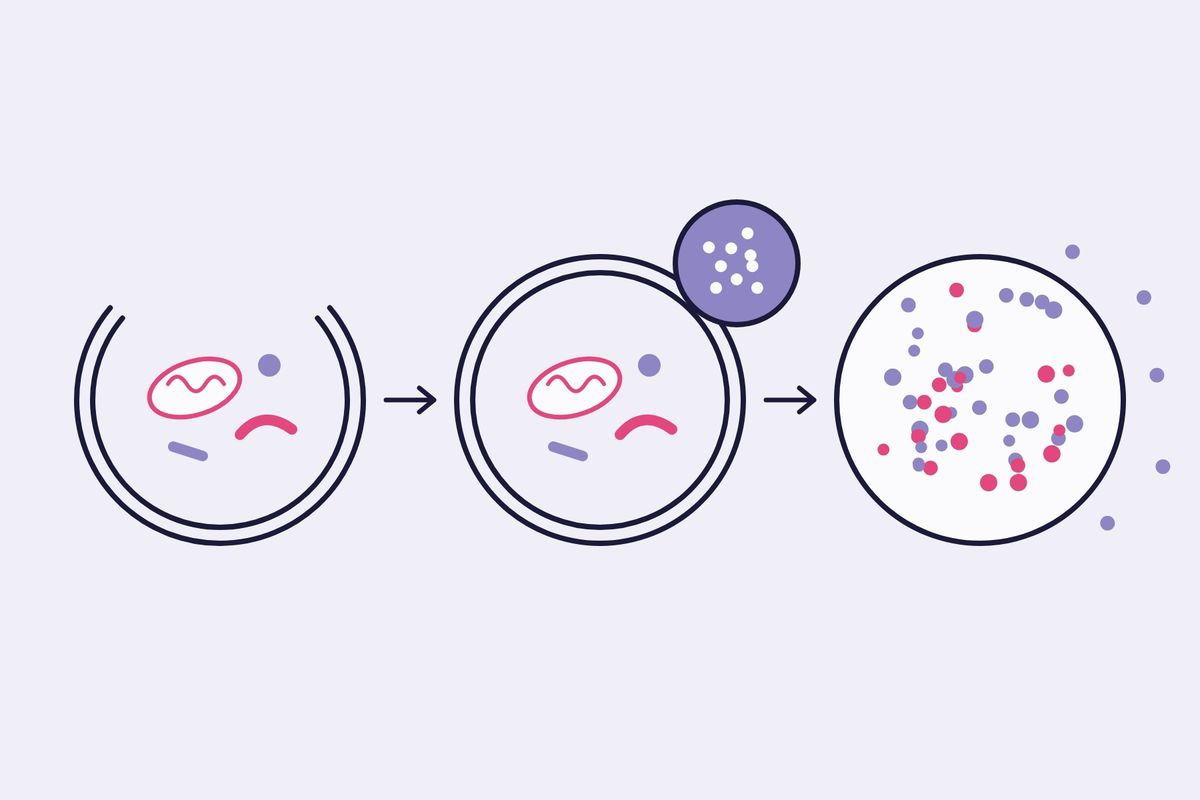
Fasting is the famous way to trigger autophagy. Spermidine triggers it without the fast.
Spermidine keeps the autophagy going, isolating the plastic particles and continuing the cleanup.
It also triggers mitophagy, clearing the damaged mitochondria so they don’t sap your energy.
Spermidine acts as a cellular shield to the toxic cascade ignited by microplastics.
Spermidine and sulforaphane are two of the only supplements shown to help remove microplastics from the body.
Spermidine also has the strongest link to a longer life
Microplastics aren’t the main reason researchers study spermidine.
In a 20-year study comparing 146 compounds, spermidine had the strongest link to a longer life of any nutrient measured. Nearly six additional years.
That’s Kiechl et al., 2018, in the American Journal of Clinical Nutrition. The researchers followed 829 adults in Italy and compared the people with the highest spermidine intake against those with the lowest.
It reaches your brain, too. Spermidine crosses the blood-brain barrier and clears the toxic protein buildup that clouds thinking and memory (Wirth et al., Cortex, 2018; Schroeder et al., Cell Reports, 2021).
If you take it, check what’s in the capsule
Most spermidine supplements use wheat germ extract: a big capsule of plant material where only about 1% of the active ingredient is actual spermidine.
Some of those labels don’t say how much spermidine is inside. They give only the weight of the wheat germ extract.
In September 2026, an independent 3rd-party lab measured the spermidine in 6 products, each in a retail package that reached the lab unopened. One serving held anywhere from 0.7 mg to 21.9 mg.
The testing was commissioned and paid for by the maker of one of the six products tested. A serving is whatever each brand’s own label says it is.
Read the lab reports for all 6 products
SPMD-99 measured highest, at 21.9 mg. Double the spermidine of 4 out of the 5 top competitors tested.
Renue By Science measured close behind it, at 19.0 mg against 8 mg on its label. Double Wood delivered the 10 mg it states.
SPMD-99 is pure spermidine with no wheat germ: 99+% pure, with no wheat, no gluten and none of the 9 major allergens.
Its 20 mg serving is the highest dose in any leading brand, and it meets or exceeds the dosage in every major study linking spermidine to a longer life.
The full table, with every product’s label beside its lab result, is in our guide to the spermidine supplements the lab measured.
Sources
- Nihart et al., Nature Medicine, 2025
- Leslie et al., Environment International, 2022
- Kiechl et al., American Journal of Clinical Nutrition, 2018
- Wirth et al., Cortex, 2018
- Schroeder et al., Cell Reports, 2021
- Read the lab reports for all 6 products
Brands have paid for promotional consideration in these articles.